
Photographing snowflakes
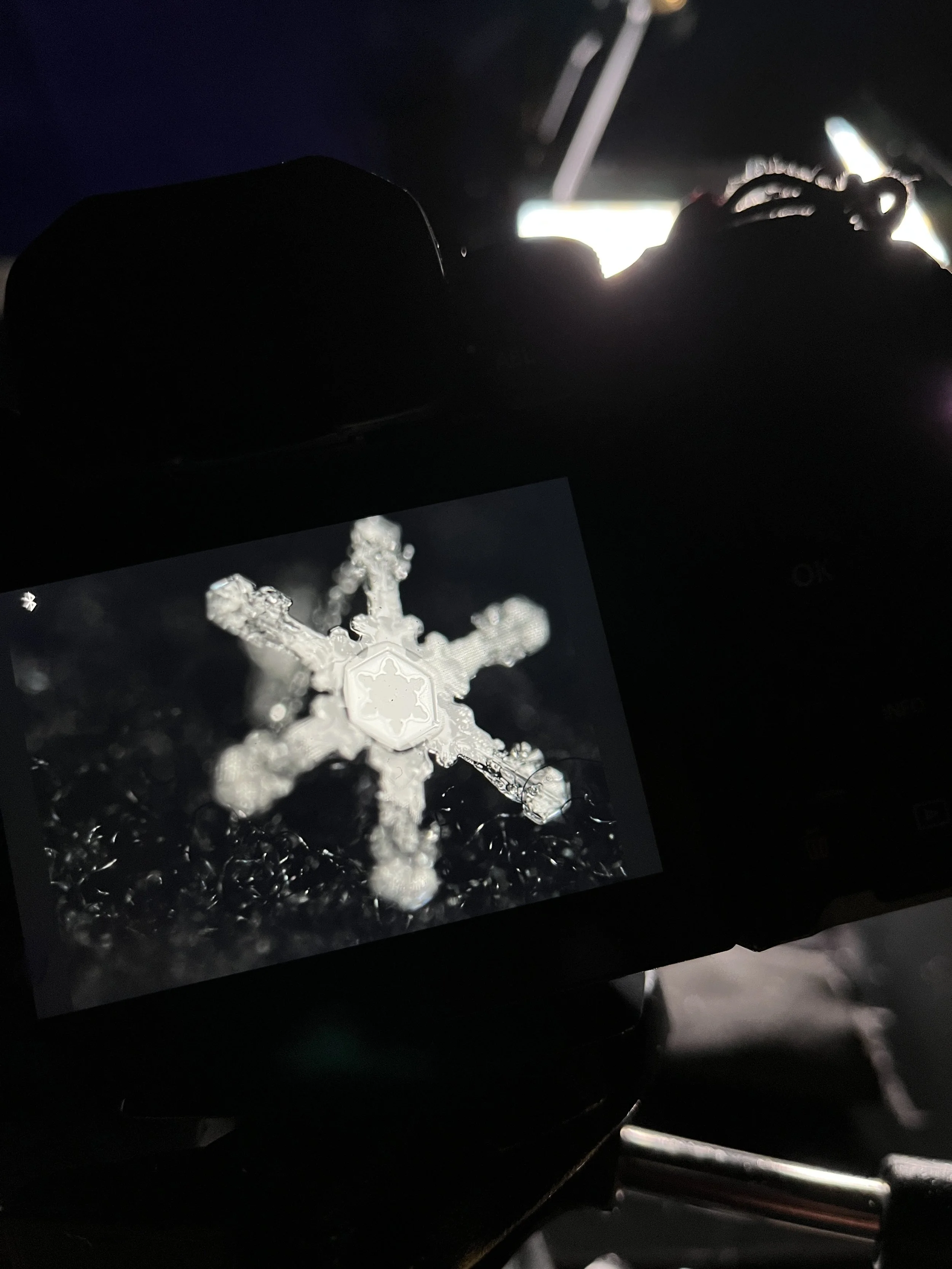
Photographing snowflakes is a quiet kind of chase—one that begins long before the camera comes out. I’ve learned that no two snowfalls behave alike; some storms scatter fragile, airy crystals, while others deliver intricate, thicker fully formed masterpieces. When the temperature slips below –3°C, the magic becomes a little easier to catch. In that colder air, the flakes linger just a moment longer before sublimating and vanishing into thin air, giving me a precious window to work.
Their shapes shift with every subtle change in temperature and humidity, so each session feels like meeting a new cast of characters. I wait with a tray lined in black fabric—sometimes an old pullover, sometimes a piece of velvet—to cradle the falling crystals. For a bit of charm and surprise, I occasionally swap in colorful glass plates, letting the background tint the scene.
My setup is a compact MFT camera paired with a macro lens, extended further with extension tubes and a teleconverter. Snowflakes come in wildly different sizes, so I’m constantly adjusting the magnification to match the scale of each tiny sculpture. I usually photograph them at a slight angle, coaxing out a three dimensional feel that reveals their delicate architecture.
At these magnifications, the plane of focus becomes razor thin. To capture a single snowflake sharply from edge to edge, I rely on focus bracketing—taking anywhere from 15 to 150 images, each with the focus nudged a fraction forward. Later, these slices are merged into one detailed portrait using focus stacking software.
The work doesn’t end there. In the editing phase, I often mask the crystal away from its background, refining the contrast between ice and shadow. From the moment a snowflake lands on my tray to the final polished image, hours can pass. But each finished photograph feels like a small triumph: a fleeting winter miracle, preserved long after it should have melted away.
Thin Film Interference in Snow Crystals
Some snowflakes display subtle patches of colour—soft blues, greens, violets, pinks or warm golds. These colours are not pigments. They come from thin film interference, an optical effect that appears when extremely thin layers form inside the crystal.
During growth, a snowflake can develop microscopic layers or cavities only a few hundred nanometers thick. These layers create boundaries between ice, air, and sometimes a trace of liquid water. When light hits these boundaries, part of it reflects from the top surface and part from the lower one. As the reflections overlap, certain colours are strengthened while others fade, producing the delicate iridescence.
Because these layers are so thin, even tiny variations—caused by temperature shifts, humidity changes, or uneven crystal growth—can alter the colours. That’s why the interference often appears as gradients, ripples, or small localized patches rather than broad, uniform areas.
Photographing this phenomenon requires:
High magnification to reveal the nanometer‑scale layers
Controlled lighting to highlight the interference
Stable temperatures, since the layers can disappear instantly
Good fortune (!)
Thin film interference is relatively rare in natural snow crystals, making each appearance a small scientific treasure. If you’d like to see real examples, the Gallery section includes several snowflakes where this phenomenon is clearly visible—each one showing how light interacts with ice at the smallest possible scale.